Trevi Fountain: History, the Coin Tradition, and the Best Time to Go
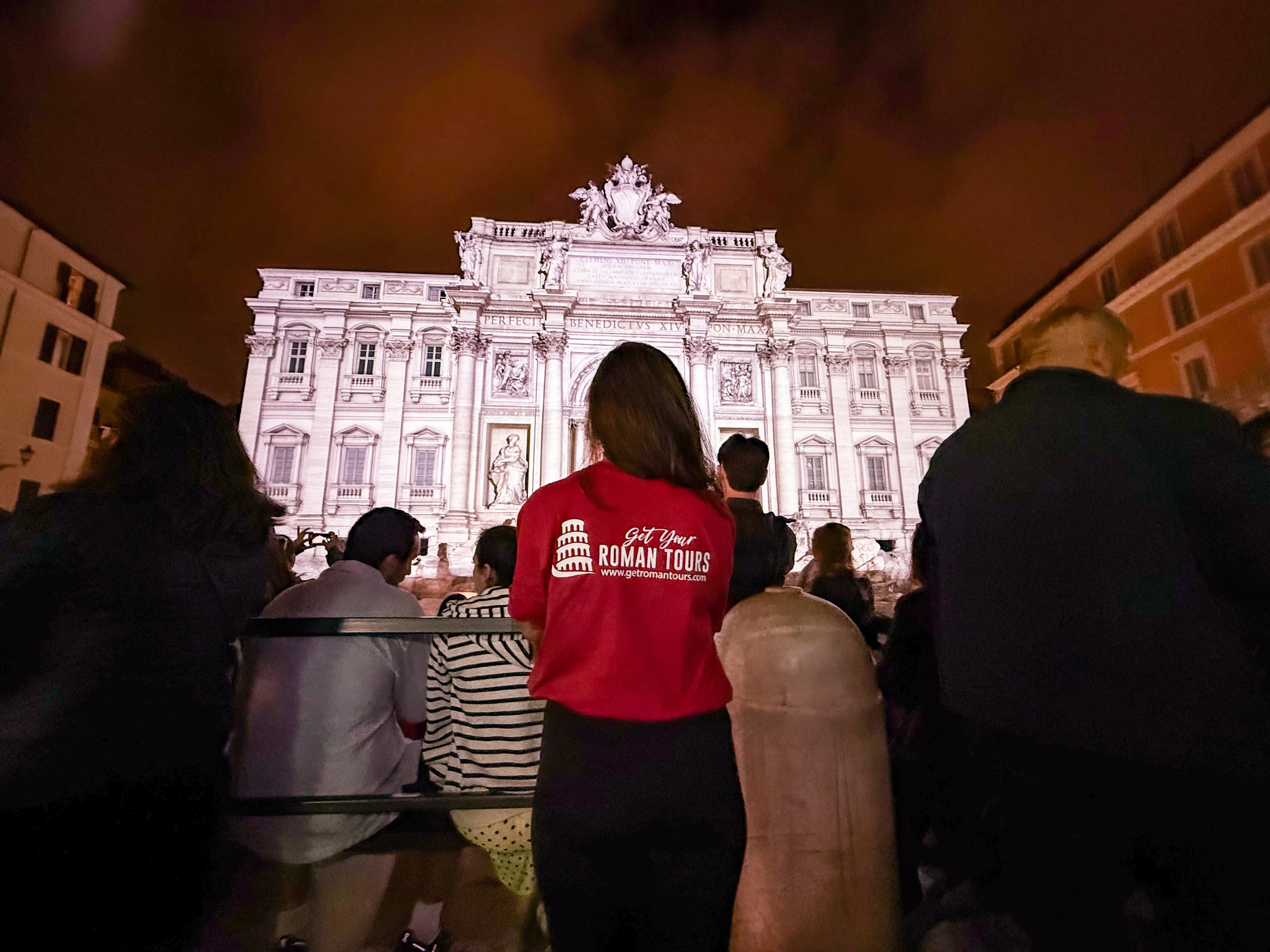
Finished in 1762 after roughly three decades of construction, the Trevi Fountain marks the end point of the Aqua Virgo, an aqueduct originally built in 19 BC under Marcus Agrippa, a close associate of Emperor Augustus. The fountain you see today draws on water that has, in some form, been flowing into this part of Rome for over two thousand years, a detail that's easy to miss amid the crowds and camera flashes.
Architect Nicola Salvi won the commission after a design competition, and his design turns the entire side of the Palazzo Poli into a theatrical stage for Neptune, god of the sea, riding a shell-shaped chariot pulled by sea horses, one calm, one agitated, said to represent the changing moods of the sea itself.
The symbolism in the sculpture
Beyond Neptune, the fountain's design is full of deliberate detail: allegorical statues representing Abundance and Salubrity (health) flank the central niche, and relief panels above them depict the legend of the aqueduct's origin, a young Roman girl supposedly showing soldiers the source spring, which gave the Aqua Virgo ('Virgin Waters') its name. Salvi himself didn't live to see the fountain completed, dying in 1751 with the work still in progress; it was finished by other architects after his death.
The coin tradition
Throwing a coin over your right shoulder with your left hand is said to guarantee a return trip to Rome, a tradition popularized internationally by mid-20th-century films but rooted in older European customs of tossing coins into wishing wells and sacred springs. The fountain collects a genuinely large sum in coins each year, and the city of Rome donates the proceeds to Caritas, a Catholic charity, to help fund social programs including a supermarket for those in need.
When to visit
Daytime hours are wall-to-wall tourists, and getting an unobstructed view of the fountain itself, let alone a clean photo, can take real patience. Early morning, around sunrise, or late at night after most tour groups have moved on are the two realistic windows to see the fountain without fighting for a sightline. Even then, the Trevi rarely empties out completely, it's simply too famous and too centrally located for that.
-
Visit before 8am or after 10pm for the clearest views and photos
-
Keep valuables close, the area is a well-known pickpocket spot given the density of distracted tourists
-
Bring small coins if you want to take part in the tradition
-
Avoid eating or drinking while sitting on the fountain's edge, it's discouraged and occasionally fined
What the fountain has been through
The Trevi has undergone several major restorations, including a widely covered cleaning project completed in 2015, funded in part by the fashion house Fendi, which scrubbed away decades of grime and pollution to reveal the original brightness of the travertine stone. The fountain has also occasionally been drained for maintenance and coin collection, offering a rare and very different look at the structure without water.
Nearby and worth combining
The Pantheon and Piazza Navona are both a short walk away, making this an easy stop on a half-day historic-center loop alongside the Spanish Steps. Our guided walking tour covers the Trevi Fountain alongside the Spanish Steps, Pantheon, and Piazza Navona in a single outing, with a guide filling in details like these that are easy to miss reading a plaque alone.
A note on respecting the site
The Trevi Fountain is, technically, a functioning piece of public infrastructure as much as a monument, and Rome has tightened rules around behavior at the site in recent years, wading into the water, sitting on the edge for extended periods, and littering can all carry fines. Treating it with the same basic respect you'd give any historic monument goes a long way toward keeping the experience pleasant for everyone nearby.
FAQ
Why do people throw coins into the Trevi Fountain?
Tradition holds that a coin thrown over the right shoulder with the left hand guarantees a return trip to Rome, a custom that became globally famous partly through film and partly through older European fountain-wishing traditions.
What happens to the coins?
They're collected regularly and donated to Caritas, a Catholic charity operating in Rome, which uses the funds to support programs including a supermarket for people in financial need.
Is the Trevi Fountain free to visit?
Yes, completely free and open at all hours, there's no ticket or entry fee, since it's a public square and fountain rather than a ticketed monument.
How crowded does it actually get?
Very, it's consistently one of the busiest single spots in central Rome during the day, on par with the Pantheon and the Spanish Steps for foot traffic.
The aqueduct behind the fountain
The Aqua Virgo is one of eleven major aqueducts that supplied ancient Rome, and notably one of the few whose route has remained at least partially functional for two thousand years, with sections of the original channel still feeding the Trevi today after various repairs and rebuilds across the centuries. Most of Rome's other ancient aqueducts fell into disrepair after the empire's fall and weren't restored until the Renaissance and later, when popes undertook major engineering projects to bring water back into the city, the Trevi itself is technically the termination point ('mostra,' or 'showpiece') of one such restoration project, designed specifically to put the aqueduct's water on dramatic public display rather than hiding it in plumbing.
This pattern (an aqueduct's outlet built as an elaborate public fountain rather than a purely functional tap) repeats across Rome at smaller scale, and is part of why the city has so many ornate fountains relative to other European capitals. Water management and civic display were deliberately combined, turning basic infrastructure into public art.
Salvi's design choices, explained
Nicola Salvi's design solves a real architectural problem: how to make a fountain feel monumental when it's built directly into the side of an existing palace rather than standing as a freestanding structure. His solution treats the entire palace facade as a theatrical backdrop, with the sculptural group appearing to emerge from a triumphal-arch-like opening framed by columns. Neptune's chariot, the sea horses, and the attendant Tritons are arranged to suggest motion and drama despite being carved from static stone, with deliberately rough-hewn 'rock' elements at the base meant to evoke a natural sea grotto rather than a formal architectural structure, a contrast against the smooth, classical columns above that was considered quite innovative for its time.
Other Roman fountains worth knowing about
The Trevi isn't Rome's only notable fountain, the Fountain of the Four Rivers in Piazza Navona, designed by Bernini, and the Triton Fountain in Piazza Barberini are both significant Baroque works by a rival sculptor-architect whose career overlapped with Salvi's era. Comparing the Trevi's theatrical classical style against Bernini's more dynamic, sculptural approach at these other sites is a useful way to start noticing the different artistic personalities at work across Rome's historic center, even for visitors without much background in art history.
Film and pop culture
The Trevi's most famous pop-culture moment is Anita Ekberg wading into the fountain in Federico Fellini's 1960 film La Dolce Vita, a scene that's heavily referenced in tourism imagery of Rome to this day, even though actually entering the water yourself is against the law and can result in a fine. The fountain has also appeared in numerous other films and is frequently used as visual shorthand for Rome itself in international media, which partly explains why it draws such intense and consistent crowds regardless of season.
Visiting at night
If there's one underrated time to see the Trevi, it's after dark once most day-trippers and tour groups have dispersed. The fountain is illuminated at night, and the lighting brings out details in the stonework that flatten out in harsh daytime sun. It's still rarely empty (the Trevi has a steady stream of visitors well into the evening) but the atmosphere shifts noticeably, and it pairs naturally with an evening stroll through the historic center if you're staying nearby.
How the surrounding neighborhood developed
The streets around the Trevi were largely shaped by the fountain's own popularity, souvenir shops, gelaterias, and small restaurants cluster densely in the surrounding blocks, catering almost entirely to the steady flow of visitors rather than residents. Quality and pricing in the immediate vicinity vary widely, and it's generally worth walking a few minutes further away from the fountain itself to find better value for food and drinks, since the closest establishments tend to charge a premium simply for proximity. Locals navigating this part of the city tend to treat the immediate Trevi area as something to pass through rather than linger in for meals, saving the lingering for quieter piazzas nearby.
Practical logistics for your visit
-
The fountain has no fixed opening hours, it's a public square, accessible 24/7
-
The nearest metro stop is Barberini (Line A), about a 5-10 minute walk
-
Public restrooms are limited nearby, plan accordingly before you arrive
-
Gelato shops near the fountain are convenient but rarely the best quality in the area, ask locals or check reviews before choosing one
Combining the Trevi with a broader historic-center walk
Because of its central location, the Trevi works well as either a starting point or a midpoint on a longer walk through Rome's historic core. A typical loop might run from the Spanish Steps, down to the Trevi, across to the Pantheon, and finishing at Piazza Navona, all comfortably walkable in an afternoon, with each stop offering a different flavor of Rome's history, from Baroque fountain art to ancient Roman engineering. Doing this walk with a guide adds context that's easy to miss reading information panels alone, particularly around how these sites relate to each other historically and geographically.
What most visitors get wrong about the Trevi
The most common mistake is treating the Trevi as a five-minute photo stop on a packed itinerary, which guarantees the worst possible experience: maximum crowd density, minimum context, and a rushed coin toss without ever really looking at the sculpture's detail. A better approach treats it as a destination in its own right worth ten or fifteen minutes of genuine attention, sitting nearby (where permitted), studying the relief panels, and reading a bit about the allegorical figures before moving on. The fountain rewards patience in a way that's easy to miss when it's just one stop among a dozen on a single day.
A short timeline
- 19 BC, Aqua Virgo aqueduct completed under Marcus Agrippa
- 1453, Pope Nicholas V restores the aqueduct, building a simpler fountain at its end point
- 1730, Pope Clement XII launches a design competition for a grander fountain, won by Nicola Salvi
- 1762, Fountain completed, three decades and several architects after Salvi's death
- 2015, Major Fendi-funded cleaning restores the stone's original brightness
How locals actually feel about the crowds
Ask a Roman who lives or works near the Trevi about the daily crowds and you'll generally get a resigned shrug rather than outright complaint, the fountain has been this popular for decades, and the surrounding businesses, while sometimes mildly exasperated by the chaos, also depend heavily on the tourism it generates. It's a useful reminder that visiting respectfully, without contributing unnecessarily to noise or litter, matters not just for your own experience but for a neighborhood that deals with this volume of visitors every single day of the year, not just during your particular visit.
Where the legend itself came from
The coin-toss custom as practiced today is younger than the fountain itself, gaining real international traction only in the 20th century, helped along significantly by its appearance in films and later by word-of-mouth among travelers. Older, related traditions of throwing offerings into sacred springs and wells exist across many European cultures going back centuries, and the Trevi's version is best understood as a modern custom grafted onto that much older instinct, that flowing water, particularly water with a documented history stretching back to antiquity, is somehow a fitting place to make a small wish or gesture toward the future.
Etiquette and respecting the site
Beyond the legal restrictions on wading into the water, basic courtesy goes a long way at a site this crowded: keeping noise reasonable in the evening when nearby residents are trying to sleep, not blocking walkways for extended photo sessions, and being mindful of personal space given how tightly packed the viewing area gets during peak hours. Rome's historic center is, after all, still a place where real people live and work, not purely a backdrop for tourism, and the Trevi sits right in the middle of one of its most densely residential and commercial pockets.
A quick comparison: Trevi versus Rome's other major fountains
Visitors short on time sometimes ask whether the Trevi is really worth prioritizing over Rome's other notable fountains, like Bernini's Four Rivers fountain in Piazza Navona or the Turtle Fountain in the Jewish Ghetto. The honest answer is that they're different enough in style and scale that it's not really an either-or choice, the Trevi is larger, more theatrical, and more famous, while Piazza Navona's fountain is more sculpturally intricate and sits in a livelier, more relaxed piazza setting. If your itinerary allows for both, seeing them within the same day or two makes for an interesting contrast in how Baroque Rome approached fountain design across different commissions and decades.
How the fountain is maintained today
City crews regularly clear coins from the basin, and the water itself is filtered and recirculated rather than drawn fresh continuously, since the volume needed to keep a fountain this size running around the clock would be impractical to source freshly at all times. Periodic deeper cleanings address algae growth and mineral buildup on the stone, and the fountain is occasionally drained entirely for more thorough maintenance, these closures are typically brief and scheduled outside peak tourist periods where possible, though they can occasionally catch visitors by surprise if a maintenance window happens to fall during their trip.
What to do if you only have ten minutes
If your schedule genuinely only allows a brief stop, prioritize getting close enough to see the relief panels and Neptune's face clearly, throw your coin if you want to take part in the tradition, and take one wide photo capturing the full facade rather than several rushed close-ups. Ten minutes isn't enough to absorb everything, but it's enough to leave with a real impression rather than just a blurry photo taken while being jostled by the crowd, and it's far better than skipping the fountain entirely simply because a longer visit isn't feasible.
Final practical summary
The Trevi Fountain costs nothing to visit, is open around the clock, and rewards visitors who give it more than a passing glance. Go early or late to avoid the worst crowds, bring a small coin for the tradition if you'd like to take part, and consider pairing it with a guided walk through the surrounding historic center to get the fullest sense of how it fits into Rome's broader story.
Want a local guide to fill in the history as you walk? Join our Rome city walking tour.