St. Peter's Basilica: Inside the World's Largest Church
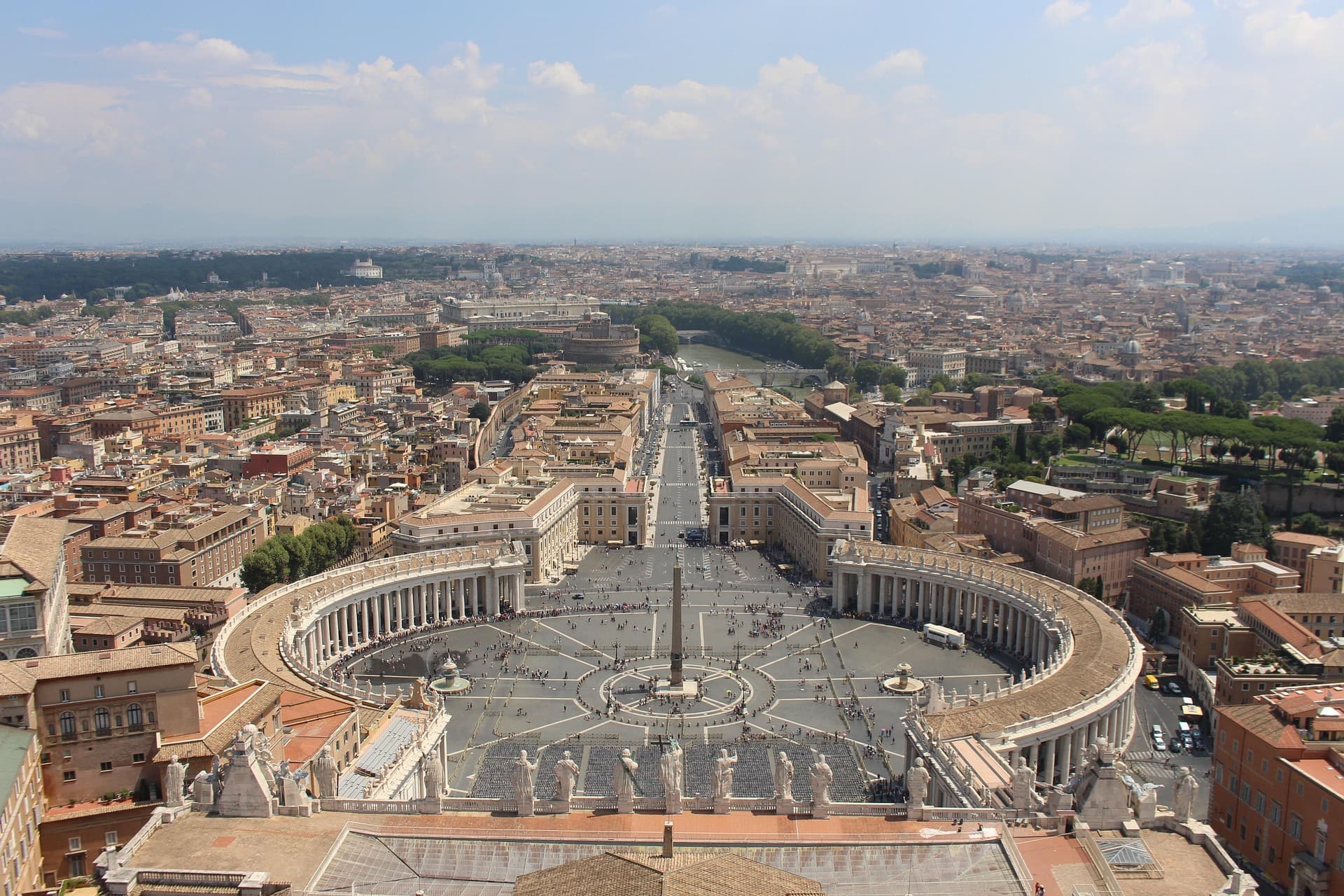
St. Peter's Basilica is, by interior floor area, the largest church in the world, a staggering 15,160 square meters of marble, mosaic, and gilded bronze built over what tradition holds is the burial site of Saint Peter himself, the apostle Catholics consider the first pope. Walking through its doors for the first time is a famously disorienting experience: the basilica's proportions are so vast and so carefully designed to trick the eye that visitors routinely underestimate its true scale until they spot another person standing at a distance and realize just how far away the high altar actually is.
Built over Saint Peter's tomb
The basilica's location isn't arbitrary. Archaeological excavations beneath the current building, conducted in the 20th century, uncovered an ancient necropolis and a simple shrine dating to the 2nd century AD, which the Catholic Church identifies as marking the burial site of Saint Peter following his martyrdom in Nero's nearby circus around 64-68 AD. Emperor Constantine built the first basilica on this site in the 4th century, and after centuries of gradual deterioration, the current building was constructed over roughly 120 years, beginning in 1506 under Pope Julius II and not completed until 1626, meaning the project outlived more than twenty popes and involved a sequence of the era's most celebrated architects.
Why Constantine built the first basilica here at all
Emperor Constantine's decision to build the original 4th-century basilica directly over the traditional site of Saint Peter's burial reflected both genuine religious conviction following his conversion to Christianity and shrewd political calculation, cementing Christianity's new official status by monumentalizing one of its most sacred sites in the empire's former capital. Building atop a hillside cemetery required enormous engineering effort, including leveling and filling sections of the slope to create a stable foundation, work so extensive that some of the ancient necropolis structures uncovered centuries later during 20th-century excavations had been deliberately preserved underground rather than destroyed, simply buried beneath Constantine's foundations.
A relay of Renaissance masters
Few buildings anywhere have passed through the hands of so many legendary architects. Donato Bramante drew the original Greek-cross plan; after his death, Raphael briefly took over before his own early death; Antonio da Sangallo the Younger made further revisions; and eventually Michelangelo, already in his 70s, was appointed chief architect in 1546, simplifying and strengthening the design and conceiving the basilica's defining feature (its enormous dome) though he died before its completion. Giacomo della Porta and Domenico Fontana finished the dome to Michelangelo's design in 1590, and Carlo Maderno later extended the building's nave and designed the facade, completed in 1614, giving the basilica its current Latin-cross floor plan rather than Michelangelo's originally intended Greek cross.
Michelangelo's Pietà
Just inside the basilica's entrance, protected behind bulletproof glass since a 1972 vandalism attack, stands Michelangelo's Pietà, a marble sculpture of the Virgin Mary cradling the dead body of Christ, carved when the artist was only in his early twenties and widely regarded as one of the greatest sculptural achievements in Western art. It's the only work Michelangelo ever signed, reportedly after overhearing visitors attribute it to another sculptor, carving his name directly across the sash on Mary's chest in a fit of pride he later said he regretted.
What to bring and best time to visit
Arriving right at opening, generally 7:00 AM, offers the calmest basilica experience before tour groups and day-trippers arrive in larger numbers. If attempting the dome climb, comfortable shoes and a reasonable level of fitness matter given the narrow stairwells and several hundred steps involved, claustrophobic visitors should be aware the final stretch narrows considerably compared to the lower sections.
Bernini's baldachin and the high altar
Towering nearly 30 meters over the high altar, directly above the traditional site of Saint Peter's tomb, stands Bernini's bronze baldachin (canopy), completed in 1633 using bronze partly stripped, controversially, from the ancient Pantheon's portico under Pope Urban VIII's orders, the same pope whose Barberini family commissioned the work and whose bees appear, predictably, carved into its decorative details. The baldachin's twisting, dynamic columns exemplify Bernini's signature Baroque style and mark the single most visually dramatic focal point inside the entire basilica.
Climbing the dome
For visitors willing to climb (either via stairs or a partial elevator), Michelangelo's dome offers two rewards: an close-up interior view of the dome's mosaic decoration from an internal gallery partway up, and, after several hundred more steps, a sweeping panoramic view over St. Peter's Square and the Roman skyline from the very top. The climb is strenuous (narrow, sometimes claustrophobic stairwells and roughly 320 steps from the elevator drop-off point) but consistently ranks among visitors' most memorable Vatican experiences specifically because of the dramatic payoff at the summit.
How Maderno's facade affected the dome's appearance
Architectural historians have long debated Carlo Maderno's decision to extend the basilica's nave and add the current facade, since doing so pushed the building's front considerably forward from where Michelangelo's original, more compact Greek-cross design would have placed it, meaning visitors standing directly in St. Peter's Square see Michelangelo's dome from much closer and at a flatter angle than the dramatic, fully visible profile he likely intended. Architectural historians generally agree the dome reads far better from a distance, such as from across the Tiber or from elevated viewpoints like the Janiculum Hill, where Maderno's facade no longer partially obscures its lower drum.
Side chapels worth slowing down for
Beyond the Pietà and the high altar, the basilica's side aisles hold numerous chapels and monuments easily missed by visitors rushing toward the dome or the famous sculptures. The Chapel of the Blessed Sacrament, generally reserved for quiet prayer rather than tourist photography, and several elaborate papal tomb monuments by artists including Bernini and Canova, line the side aisles with a density of significant artwork that, in almost any other building, would constitute a major standalone attraction. Slowing down for even a brief look at two or three of these side chapels gives a far fuller sense of the basilica's accumulated artistic wealth than a straight walk down the central nave alone.
The Vatican Grottoes and papal tombs
Beneath the basilica's main floor lie the Vatican Grottoes, a crypt-level area containing the tombs of numerous popes across the centuries, accessible free of charge to visitors as part of a standard basilica visit. Pope John Paul II's tomb, located here until his 2011 beatification prompted its relocation to a more accessible chapel upstairs, remains one of the most visited single tombs in the complex, alongside the traditional site of Saint Peter's burial itself, accessible via a separate, smaller, advance-booking-required excavation tour beneath the grottoes known as the Scavi tour.
A short history recap, if you're short on time
- 2nd century AD: an early shrine marks the traditional burial site of Saint Peter beneath what will become the basilica
- 4th century: Constantine builds the first basilica directly over the site
- 1506: construction begins on the current basilica under Pope Julius II and architect Donato Bramante
- 1546: Michelangelo is appointed chief architect, conceiving the basilica's defining dome
- 1590: Giacomo della Porta and Domenico Fontana complete the dome to Michelangelo's design
- 1626: the basilica is formally consecrated, completing a project spanning roughly 120 years and more than twenty popes
Few buildings anywhere have absorbed this many distinct architectural visions across so many generations and still emerged as a coherent, unified whole, a testament to how seriously successive popes treated the responsibility of finishing what their predecessors had started.
Walking through the finished basilica today, it's genuinely difficult to detect the seams between Bramante's original plan, Michelangelo's revisions, and Maderno's later additions, a deliberate, hard-won architectural unity achieved across more than a century of changing hands.
That seamlessness is itself a kind of achievement worth appreciating on its own terms, a building shaped by at least five major architects across five generations, somehow reading today as the work of one singular, coherent vision.
Whatever draws you here (faith, art history, or simple curiosity about the world's largest church) give yourself enough unhurried time to actually walk its full length, slowly, rather than rushing straight to the highlights and leaving the rest unseen, side chapels and all.
Visiting practically
-
Basilica entry is free; the dome climb and treasury museum require separate paid tickets
-
Strict dress code applies: shoulders and knees covered for all visitors, no exceptions
-
Security screening is required before entry, similar to airport-level checks
-
Lines can exceed an hour at peak times; early morning (before 8:30 AM) offers the shortest wait
-
The Scavi tour to Saint Peter's tomb itself requires advance booking, often weeks ahead, and is not available as a walk-up ticket
What the souvenir and gift shop area offers
Near the basilica's exit, a Vatican-operated gift shop and post office area sells religious items, books, and Vatican-specific postage stamps, including the option to mail postcards bearing an official Vatican City postmark, a small, genuinely low-cost souvenir that doubles as easy proof of having technically visited a wholly separate, fully sovereign nation during your trip to Rome. The post office operates under its own distinct Vatican postal service, separate entirely from the Italian postal system, another small but genuine marker of the territory's independent statehood, distinct in every formal sense from the country surrounding it.
Mass times and attending a service
Visitors interested in attending an actual Mass rather than simply touring the basilica can do so freely, since multiple Masses are celebrated daily in various side chapels alongside the larger, less frequent ceremonies held at the high altar reserved for major occasions and papal celebrations specifically. Attending a regular daily Mass offers a markedly different, far more contemplative way to experience the basilica's atmosphere compared to a typical daytime sightseeing visit, away from the busiest tourist flow.
The Holy Door, opened only during Jubilee years
Among the basilica's five entrance portals is the Holy Door, a bronze door that remains permanently sealed except during designated Jubilee years (special, periodically declared years of pilgrimage and indulgence in Catholic tradition), when the pope ceremonially opens it to mark the start of the celebration. Passing through the Holy Door during an active Jubilee carries particular spiritual significance for pilgrims, and the door's otherwise sealed, inert state during ordinary years is a small but telling reminder of how much of the basilica's design and use is governed by liturgical calendars most casual visitors never think to ask about.
What the bronze doors at the entrance show
Before stepping inside, it's worth pausing at the basilica's main bronze entrance doors, cast in the 15th century by Antonio Averlino (known as Filarete) for the earlier Constantinian basilica and later relocated to the current building, making them, remarkably, older than the basilica that now surrounds them. The doors depict scenes including the martyrdoms of Saints Peter and Paul, and their survival across the transition from the ancient basilica to Bramante and Michelangelo's entirely new building represents one of the few direct physical links between the current structure and its much older predecessor.
Why the dome climb divides opinion
Visitor opinions on the dome climb tend to split sharply: some consider the panoramic reward at the top among the best views in all of Rome, easily justifying the physically demanding ascent through narrow, occasionally claustrophobic stairwells; others find the climb genuinely uncomfortable, particularly during the busier summer months when the stairwell can feel cramped and overheated with fellow climbers moving slowly in both directions along the same narrow passage. Travelers with claustrophobia, significant mobility limitations, or simply limited tolerance for tight spaces should weigh this honestly before committing, since there's effectively no way to turn back partway up most of the route.
Getting there and pairing it with other sights
St. Peter's Basilica sits at the far end of St. Peter's Square, reachable via the Ottaviano Metro stop (Line A) followed by a 10-minute walk. Most visitors combine a basilica visit with the Vatican Museums and Sistine Chapel on the same day, given their close proximity, though the combined visit easily fills a full day given the scale of all three.
How the basilica compares to other major churches
St. Peter's Basilica is sometimes confused with Rome's actual cathedral, San Giovanni in Laterano, which holds the formal title of the Pope's cathedral as Bishop of Rome, even though St. Peter's is far more famous and far more visited internationally. St. Peter's instead derives its supreme significance from its association with the apostle's tomb and its status as the principal church of the Vatican itself, a distinction that surprises many visitors who assume, reasonably enough given its scale and fame, that it must also hold the cathedral title.
Frequently asked questions
Is St. Peter's Basilica free to enter?
Yes, basilica entry is free. Only the dome climb and the treasury museum require separate paid tickets.
How long does a basilica visit take?
A focused visit covering the main nave, Pietà, and baldachin takes 45-60 minutes. Add 45-90 minutes for the dome climb if attempting it.
What is the Scavi tour?
A separate, advance-booking-required tour beneath the Vatican Grottoes leading to the traditional excavated site of Saint Peter's tomb itself, distinct from the standard, free basilica visit.
Can you take photos inside?
Yes, photography without flash is generally permitted throughout the main basilica, though commercial photography requires separate permission.
The basilica's sheer numbers
Some scale comparisons help put St. Peter's size in perspective: its interior could comfortably contain several other major European cathedrals within its footprint, its dome rises roughly 136 meters above the floor, and the building's foundations required engineering solutions so advanced for their time that they influenced large-scale construction techniques across Europe for generations afterward. Standing at the entrance and looking toward the distant high altar, most visitors significantly underestimate the actual distance until they see another person standing near it, looking comparatively tiny against the surrounding marble.
What the treasury museum adds
For visitors with extra time and a paid ticket, the basilica's treasury museum (Museo del Tesoro) houses liturgical objects, vestments, and historical artifacts accumulated across centuries of papal ceremony, including items connected to specific historical popes and major Church events. It's a smaller, more specialized stop compared to the basilica's main attractions, generally appealing most to visitors with a particular interest in ecclesiastical history or decorative arts rather than casual first-time sightseers focused on the Pietà, the baldachin, and the dome.
Why the scale still surprises first-time visitors
No photograph or description quite prepares first-time visitors for how genuinely enormous St. Peter's Basilica is in person, a deliberate design choice by Renaissance and Baroque architects who understood that scale itself could communicate religious awe more effectively than any single decorative detail. Walking its full length from entrance to altar, passing chapel after chapel each large enough to be a substantial church in its own right elsewhere, remains one of the most genuinely overwhelming indoor experiences available anywhere in the world.
Walking the full length of the nave slowly, rather than rushing straight to the most famous highlights, gives a far truer sense of the building's genuine scale.