Colosseum, Rome: History, Tickets, and What to Expect Inside
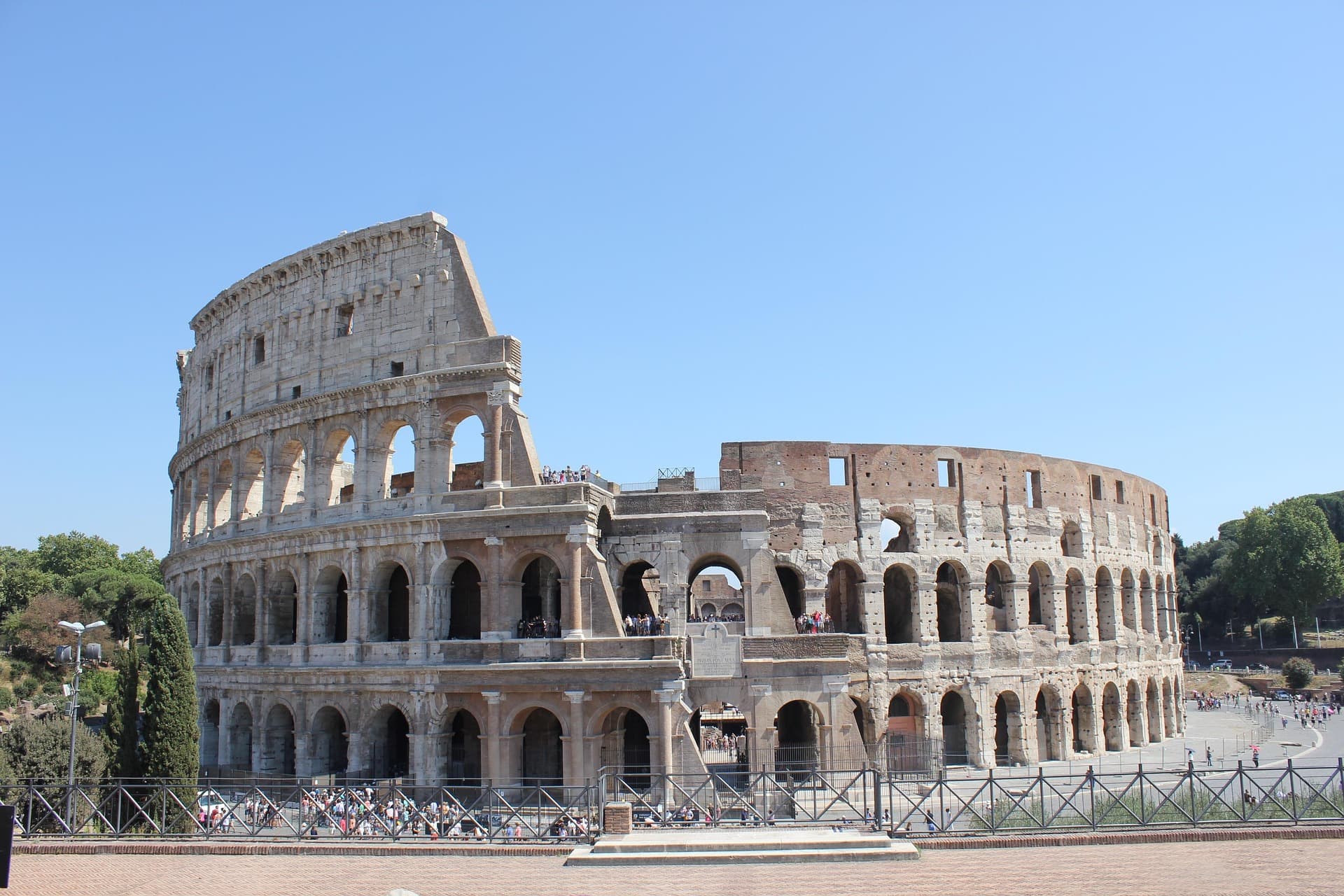
Completed around 80 AD under Emperor Titus, and begun a decade earlier under his father Vespasian, the Colosseum could hold an estimated 50,000-80,000 spectators for gladiator contests, animal hunts, and public spectacles that sometimes ran for weeks at a stretch. Almost 2,000 years later it remains the single most-visited site in Rome, and arguably the most recognizable building from the ancient world still standing anywhere.
Its official Latin name was the Amphitheatrum Flavium, after the Flavian dynasty that built it, the nickname 'Colosseum' likely comes from a colossal bronze statue of Nero that once stood nearby, not from the building's own size, though the size earned the name regardless over the following centuries.
How it actually worked
The Colosseum's basic design (a freestanding oval bowl with tiered seating around a central arena) became the template for essentially every stadium built since, including the one in your home city. Seating was strictly organized by social class: senators and VIPs at arena level, ordinary citizens climbing higher the further down the social ladder they sat, and the poorest spectators and women in standing-only sections at the very top, under a wooden colonnade.
Beneath the arena floor sat the hypogeum, a two-level network of tunnels, animal cages, and trapdoors connected to a system of ropes and counterweighted lifts. Animals and scenery could be hauled up and released directly into the arena through trapdoors, creating effects that must have looked close to magic to an audience with no idea what mechanism was producing them.
What you're actually looking at today
The structure you see now is a shell of the original. Most of the marble facing, decorative statues, and the iron clamps holding stone blocks together were stripped away over centuries, the iron for reuse, the marble for new buildings including, reportedly, parts of St. Peter's Basilica. What remains is largely the structural brick and concrete core, along with sections of the original travertine stone facade on one side.
Certain ticket types now include access to the hypogeum and the top tier (the 'Belvedere'), both requiring a guided visit rather than free wandering. The hypogeum tour in particular gives a genuinely different sense of the building, seeing the arena floor from below, through the same tunnels gladiators and animals once moved through, changes how the whole structure reads.
Tickets and getting in
A standard ticket covers the Colosseum, Roman Forum, and Palatine Hill, valid for 24 hours across all three sites with a single entry to each. Security checks are mandatory and can be slow, particularly in the late morning, so a skip-the-line entry with an audio guide saves real time, not just money, the line for ticket holders without a pre-booked slot can run well past the security checkpoint itself on a busy day.
-
Bring a valid photo ID matching the name on your ticket
-
Arrive at least 15 minutes before your entry slot
-
Pack water, there's limited shade inside the arena and seating areas
-
Wear sturdy, flat shoes, the ancient stairs and walkways are uneven
Best time to visit
The first entry slot of the day or the last two hours before closing tend to be the quietest. Midday in summer is both the most crowded window and the hottest, with almost no shade across the upper tiers. Visiting on a weekday rather than a weekend shaves some time off the security queue, though it rarely eliminates it entirely given how consistently popular the site is year-round.
Large bags, tripods, and selfie sticks are not permitted inside. Bag checks are similar in thoroughness to airport security, and oversized luggage will need to be left behind or stored elsewhere before you arrive.
Pairing it with the Forum and Palatine Hill
Most visitors do the Colosseum first, then walk down into the Roman Forum, finishing on Palatine Hill for the best single view back over the ruins. Budget the better part of a morning or afternoon for all three, rushing the Forum in particular tends to be the most common regret visitors report afterward, since its scattered ruins reward a little patience and context that's easy to miss walking through quickly.
What guides tend to point out that signage doesn't
A guide will usually flag a few details easy to miss on a self-guided visit: the graffiti and inscriptions left by ancient spectators on certain stone surfaces, the precise mechanics of how the velarium (a retractable awning system) likely worked to shade parts of the audience, and the surprising amount of evidence for how quickly the building's purpose shifted after gladiator combat was banned in the 5th century, including its later use as housing, workshops, and even a quarry for building materials.
FAQ
How long should I spend at the Colosseum?
Plan on 60-90 minutes inside the Colosseum itself, plus another 1.5-2 hours if you're continuing to the Forum and Palatine Hill on the same ticket.
Is the Colosseum wheelchair accessible?
The ground level and arena floor are accessible via a lift; the upper tiers have more limited access. It's worth checking current accessibility notes when booking, since access routes are occasionally adjusted during conservation work.
Can I visit the underground hypogeum?
Yes, but only on specific ticket types that include a guided hypogeum and Belvedere tour, standard tickets don't grant access to those areas, since they require a guide for safety and preservation reasons.
Is the Colosseum worth visiting if I've already seen photos of it?
Almost universally yes, photos flatten the scale in a way that's hard to appreciate until you're standing inside it, particularly looking down into the arena from the upper tiers.
What's the best photo spot?
The upper tiers looking down into the arena and hypogeum give the most dramatic interior shot; from outside, the side with the surviving travertine facade photographs best in late afternoon light.
The gladiators who fought here
Gladiators were not, generally, free citizens, most were slaves, prisoners of war, or condemned criminals, though a smaller number were free men who volunteered for the fame and prize money, since a successful gladiator could become a genuine celebrity in Roman society. They trained in dedicated schools (ludi) under a manager called a lanista, and contests followed rules and conventions far more structured than the chaotic free-for-all popular culture sometimes imagines, specific weapon-and-armor pairings faced off against each other, and a referee could stop a fight before it turned fatal. Death in the arena was common but not universal; a defeated gladiator who fought well could be spared at the crowd's request, signaled by gestures whose exact meaning is still debated by historians today.
Animal hunts (venationes) were a separate, equally popular category of spectacle, involving exotic animals shipped in from across the empire's furthest provinces, lions and leopards from North Africa, bears from northern Europe, even reports of elephants, rhinoceroses, and crocodiles. The logistics alone, moving and housing dangerous animals from thousands of miles away in an era without modern transport, give some sense of the resources the empire was willing to commit to public entertainment.
How the Colosseum was built so quickly
Construction took roughly eight to ten years, remarkably fast for a structure of this scale using the technology of the time. Roman engineers achieved this partly through standardization, the travertine blocks, brick-faced concrete, and tuff stone used throughout follow repeated, modular patterns rather than bespoke one-off designs, letting different teams work on different sections simultaneously using the same techniques and materials. Roman concrete itself, made with volcanic ash (pozzolana) mixed into the mortar, is part of why the structure has survived: it's remarkably durable, and modern engineers still study its composition for clues that might improve contemporary concrete's longevity.
The numbering system carved above the entrance arches (many still legible today) functioned much like a modern stadium's gate numbers, directing ticket holders to their assigned section via the correct staircase, letting tens of thousands of people enter and find their seats without the kind of bottleneck a single shared entrance would create. It's one of the clearest pieces of evidence for just how sophisticated Roman crowd management already was two thousand years ago.
What happened to the Colosseum after Rome fell
Gladiator games were formally banned in the early 5th century, and animal hunts followed not long after, partly due to the rising influence of Christianity, which viewed the bloodsport as incompatible with its values. After that, the building's history gets considerably less glamorous: it was damaged by earthquakes in the 5th and 9th centuries, used as housing and workshops during the medieval period, occupied at one point by a religious order, and systematically stripped for building materials over centuries, a fate shared by many ancient Roman structures once their original purpose disappeared. Serious preservation efforts only began under papal initiative in the 18th century, and active conservation work, including a major exterior cleaning completed in 2016, continues today.
Visiting with kids or limited mobility
Families generally find the Colosseum engaging for children old enough to grasp basic historical concepts, the scale and the gladiator history tend to capture kids' imaginations more readily than the more abstract Forum ruins next door. That said, the uneven ancient stonework, occasional steep staircases, and lack of shade mean strollers can be impractical inside; a baby carrier tends to work better. For visitors with mobility considerations, a lift provides access to the arena floor level, though some upper sections remain harder to reach, checking current accessibility details when booking is worthwhile since access points are occasionally adjusted for conservation work.
How the Colosseum compares to other ancient amphitheaters
Several other well-preserved Roman amphitheaters survive across the former empire (in Verona, El Djem in Tunisia, and Pula in Croatia, among others) but none match the Colosseum's scale or fame. Part of that is simple size: at roughly 189 by 156 meters, it was the largest amphitheater the Romans ever built, and remains the largest ever built anywhere until far more recent stadium construction. Part of it is also pure cultural visibility, its appearance in countless films, books, and the broader popular imagination has made it a symbol of ancient Rome more generally, not just of this one specific building.
The emperors behind the building
Vespasian, who began construction, came to power in 69 AD after a chaotic year that saw four different emperors, a period now remembered as the Year of the Four Emperors. Commissioning a massive public amphitheater was, among other things, a calculated piece of political messaging: a gift to the Roman people, built partly on the site of Nero's hugely unpopular private palace grounds, signaling a return to public-spirited rule after a widely resented predecessor. Titus, his son, opened the building with games reportedly lasting 100 days, and Domitian, his other son, added the final tier and the underground hypogeum in the years after. The building is, in a real sense, a three-generation family project, with each emperor's contribution still visible to a trained eye in the construction.
This political dimension is easy to overlook focusing purely on the architecture, but it's central to why the Colosseum was built at all: Roman emperors used large-scale public entertainment and monumental construction as deliberate tools of popularity and legitimacy, a practice often summarized by the phrase 'bread and circuses.' Free public spectacle on this scale doubled as a powerful statement of imperial generosity and competence.
Modern conservation and the cleaning project
Centuries of pollution from Rome's traffic had left the Colosseum's exterior visibly blackened by the early 2000s, prompting a major restoration funded by the luxury brand Tod's, completed in stages and finished around 2016. The cleaning revealed a notably paler, almost golden stone color much closer to how the building would have looked when newly built, a reminder that our mental image of 'ancient ruins' as uniformly gray and weathered isn't necessarily how these buildings appeared to the people who built them. Conservation work continues on an ongoing basis, including periodic structural assessments and targeted repairs to sections most exposed to weather and tourist foot traffic.
Seasonal crowd patterns across the year
Spring (April-May) and fall (September-October) draw the heaviest combination of pleasant weather and tourist volume, making early entry slots especially valuable during these months. Summer (June-August) brings the largest absolute crowds along with serious heat, the stone retains warmth and the upper tiers offer no relief from direct sun, so an early morning or last-entry slot becomes less of a preference and more of a necessity for comfort. Winter (November-March) is consistently the quietest season, with shorter lines and a noticeably calmer atmosphere inside, even around the Christmas and New Year period when overall city tourism ticks back up; if flexibility allows, winter is genuinely the most pleasant time to experience the Colosseum without crowds dictating your pace.
Putting together a full ancient-Rome day
For visitors with a single day to dedicate to ancient Rome, a sensible structure runs: Colosseum first thing in the morning when it's coolest and least crowded, followed by the Roman Forum, then Palatine Hill, finishing around midday or early afternoon. This sequence lets you front-load the most physically demanding and popular site while energy and patience are both highest, then wind down through the more contemplative, less crowded Forum and hill. Pairing this with a relaxed lunch in the Monti neighborhood just north of the Colosseum (a genuinely pleasant, less touristy pocket of central Rome) rounds out a full and well-paced day around the empire's most famous monument.
Things people ask the night before
A surprising number of visitors message us the night before their Colosseum visit asking variations of the same handful of questions: whether they need to print their ticket (a phone screenshot or app confirmation is generally fine, but check your specific ticket type's instructions), whether the audio guide works offline (most run through an app that requires data or a pre-downloaded file, so checking in advance saves a frustrating moment at the gate), and whether children need their own ticket (in most cases, yes, though pricing for younger children is often discounted or free depending on age, check the specific terms when booking). None of these are complicated questions, but getting clear answers the night before rather than discovering an issue at the security line makes the actual visit noticeably smoother.
Final word
The Colosseum earns its reputation honestly, few buildings anywhere combine this much engineering ambition, political history, and sheer staying power in one place. Give it the time it deserves, book ahead to avoid the worst of the line, and pair it with the Forum and Palatine Hill for the fullest possible picture of ancient Rome in a single outing.
A short timeline of the Colosseum
- 72 AD, Construction begins under Emperor Vespasian
- 80 AD, Completed and inaugurated under Emperor Titus, with 100 days of games
- 96 AD, Domitian adds the fourth tier and underground hypogeum
- 523 AD, Last recorded gladiatorial games
- 1349, A major earthquake causes significant structural damage
- 18th century, Papal preservation efforts begin in earnest
- 2016, Major exterior cleaning project completed
Skip the regular line entirely. Book Colosseum tickets with audio guide.