St. Peter's Basilica & The Iconic Dome: A Complete Guide to History, Art & Architecture
St. Peter's Basilica in Vatican City is not simply the largest church in the world. It is a 500-year love letter from the Catholic Church to God, built on ground where the Apostle Peter was believed to have been martyred, layer upon layer of human ambition, faith, grief, and genius stacked on top of itself like geological strata. You can feel all of that weight the moment you step through the front doors.vb
I want to take you through it not as a dry Wikipedia entry, but as someone genuinely fascinated by what this building represents architecturally, historically, and humanly.
A Brief History: From Constantine to Michelangelo
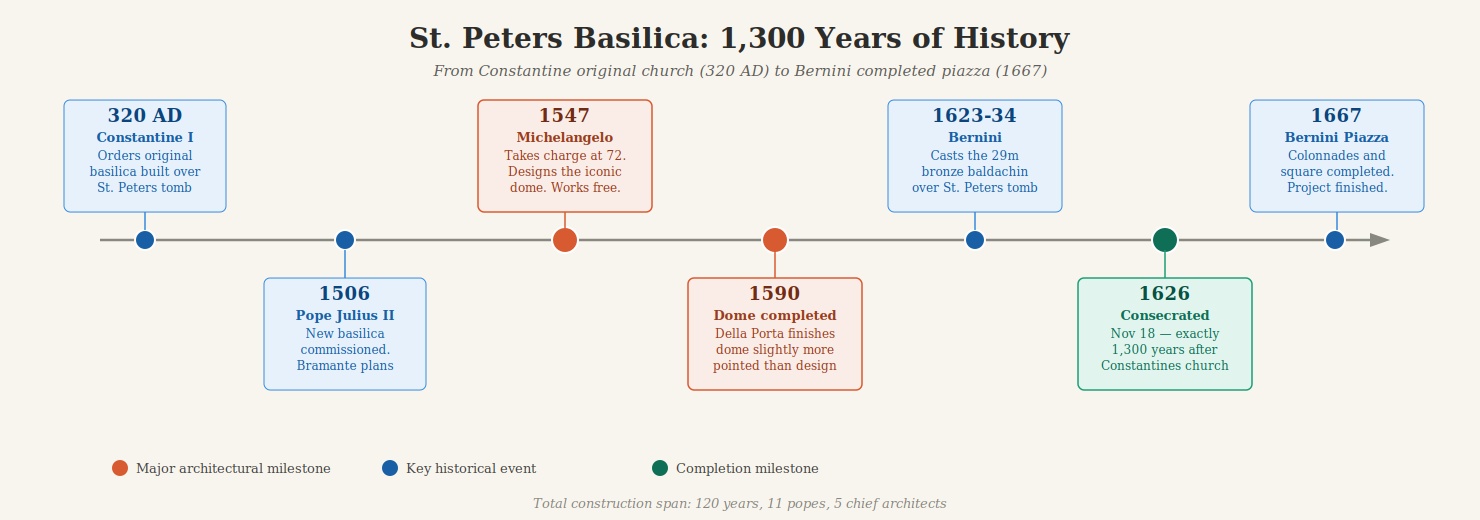
The story of St. Peter's Basilica begins in the fourth century. Emperor Constantine I, the first Roman emperor to convert to Christianity, ordered the construction of the original basilica around 320 AD. It was built directly over what was believed to be the burial site of Saint Peter, the apostle who became the first Bishop of Rome a fact that explains everything about why this particular spot became the spiritual center of Western Christendom.
That original Constantinian basilica stood for more than a thousand years. By the late 1400s, however, it was crumbling. Pope Nicholas V commissioned a rebuild. Then came Julius II, the warrior-pope who decided in 1506 that what was needed was not a restoration but an entirely new basilica something that would leave no doubt about the power and permanence of the Church.
What followed was arguably the most extraordinary architectural relay race in history. Donato Bramante drew up the first plans. Then came Raphael, then Antonio da Sangallo the Younger, then the name that still echoes through every corner of the building Michelangelo, who took charge in 1547 at the age of 72 and refused payment, calling it the work of his soul. After Michelangelo came Giacomo della Porta, Carlo Maderno, and finally Gian Lorenzo Bernini, who completed the piazza. Construction lasted 120 years.
The basilica was consecrated on November 18, 1626, exactly 1,300 years after the original Constantinian church had been consecrated.
.jpg)
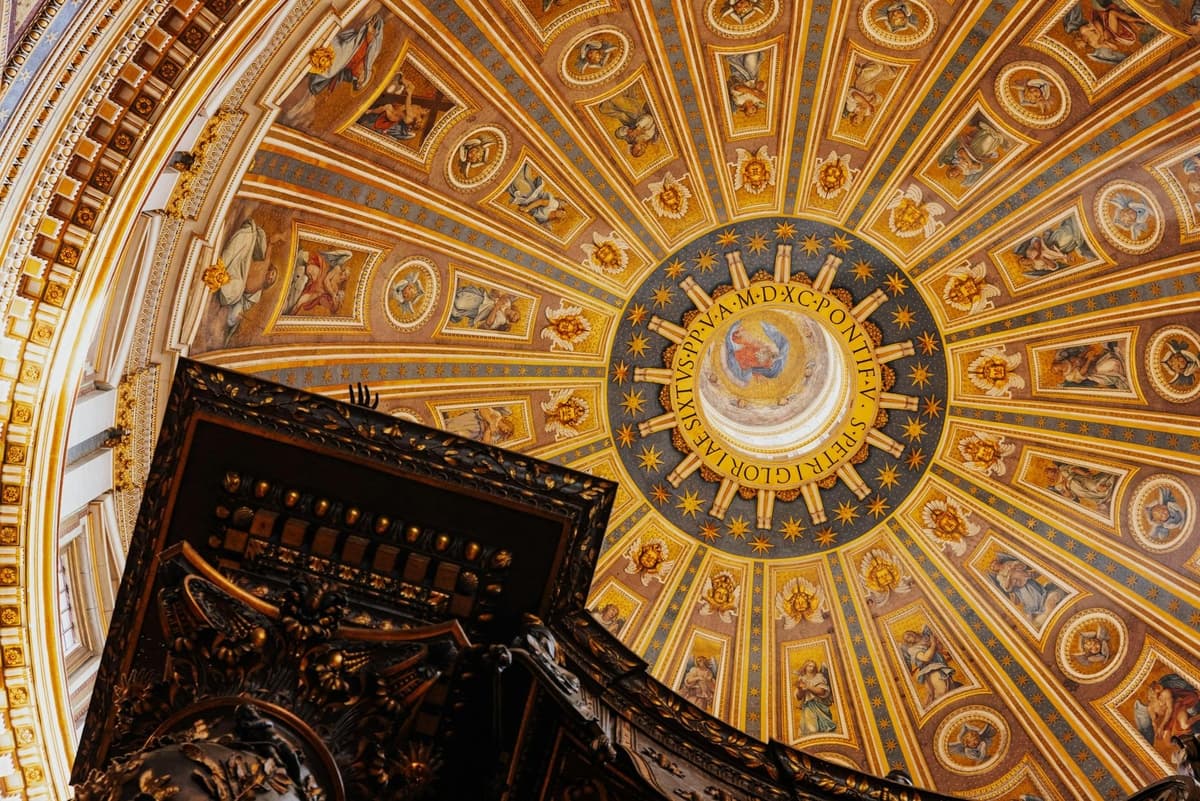
The interior mosaic ceiling
Looking up from inside the basilica into the dome, you see one of the most extraordinary interior spaces in the world. The dome is decorated entirely with mosaics — not frescoes, because the humidity inside the building would have destroyed painted plaster. The mosaics were designed by various artists and executed over decades, depicting Christ in majesty at the very top, surrounded by the Virgin Mary, Saint John the Baptist, and the Apostles. The words circling the base of the dome in enormous gilded letters form a verse from Matthew 16:18: "You are Peter, and on this rock I will build my Church." The letters are each 2 metres tall.
Inside the Basilica: Art, Altars & Sacred Spaces
The interior of St. Peter's is not exactly a single space it is a procession of spaces, each one loaded with significance. You move from the narthex through the central nave toward the crossing under the dome, then into the apse beyond. Along the way, virtually every surface, every alcove, and every chapel is an art history lesson..
Michelangelo's Pietà
Just inside the main entrance, in the first chapel on the right, sits Michelangelo's Pietà — and it stops people in their tracks every time. Carved when Michelangelo was just 24 years old, it shows the Virgin Mary holding the body of Christ after the crucifixion. The technical mastery is staggering: the marble seems to breathe, the drapery folds with a logic that defies stone. The face of Mary, serene rather than grief-stricken, is often read as representing divine acceptance of divine will. It is protected behind bulletproof glass since an attack with a hammer in 1972.
Bernini's baldachin
Directly beneath the dome, over the tomb of Saint Peter, stands Bernini's baldachin — a 29-metre-tall bronze canopy that serves as the ceremonial altar of the Pope. It was cast between 1623 and 1634, and it required so much bronze that Pope Urban VIII controversially stripped the bronze from the Pantheon's portico to provide the material. ("What the barbarians didn't do, the Barberini did," Romans said acidly, a reference to the pope's family name.) The four twisted columns, their surfaces crawling with bronze laurel branches, bees (the Barberini family emblem), and cherubs, are one of the great Baroque theatrical gestures in all of art.
The Papal tombs and the crypt
Beneath the main floor lies the Vatican Grottos, accessible to visitors, where dozens of popes are buried — including John Paul II, whose tomb became an immediate place of pilgrimage after his death in 2005. Deeper still, beneath the grottos, is the Necropolis — an ancient Roman cemetery where excavations in the 1940s uncovered what Vatican archaeologists believe are the bones of Saint Peter himself. Access to the Necropolis requires a separate, advance booking, but the two-hour guided tour is, for those interested in early Christian history, one of the most extraordinary things you can do in Rome.
St. Peter's Square and Bernini's Embrace
You cannot really understand the basilica without understanding the piazza in front of it. Bernini designed St. Peter's Square between 1656 and 1667, and his concept — two curved colonnades reaching out from the facade like a pair of arms — is one of the most emotionally intelligent pieces of urban design ever conceived. Bernini himself described it as the Church "opening her arms to receive Catholics, to reunite heretics, to enlighten unbelievers."
The colonnades consist of 284 columns and 88 pilasters arranged in four rows, topped by 140 statues of saints. In the center of the elliptical piazza stands an ancient Egyptian obelisk, brought to Rome by Emperor Caligula in 37 AD. There are two fountains — one by Maderno, one by Bernini. Stand on either of the two small round stones embedded in the piazza's pavement (marked Centro del Colonnato) and the four rows of columns line up perfectly into a single row, an optical illusion Bernini deliberately engineered into the design.
Climbing the Dome: What to Expect
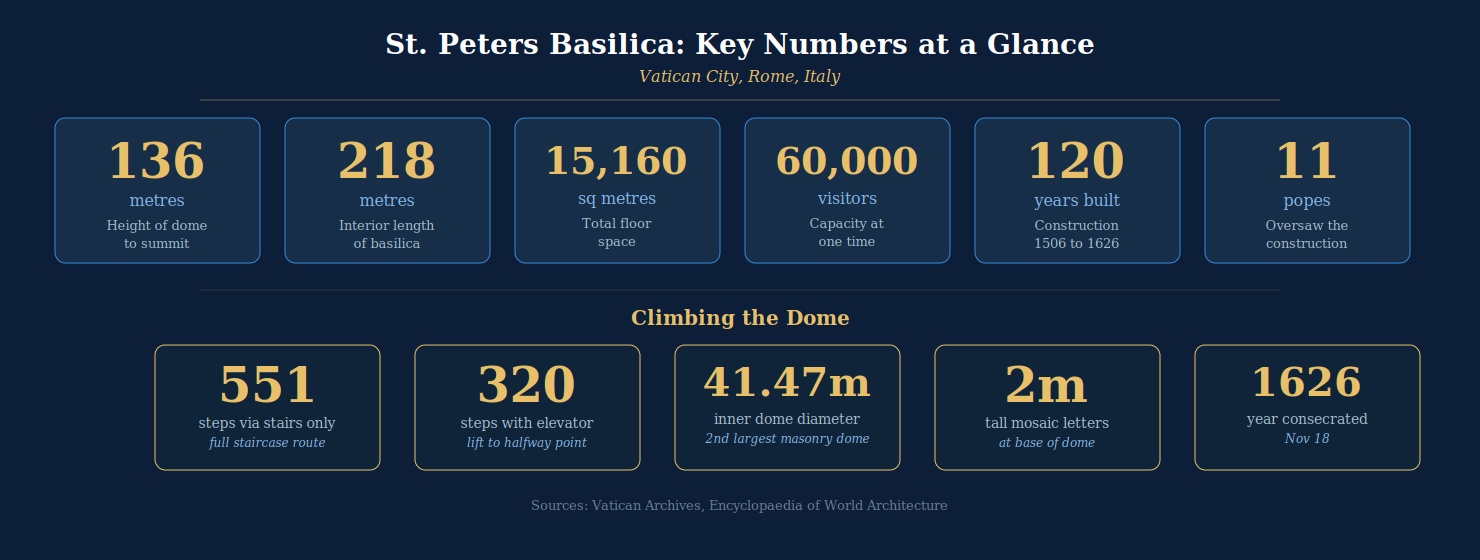
You can climb to the top of the dome, and you absolutely should, though you should know what you are getting into. There are two options: stairs all the way (551 steps) or an elevator partway, followed by 320 steps. Even with the elevator, the final stretch involves a narrow, spiraling staircase that leans with the curve of the dome itself the walls slope inward above you, and it is not for the claustrophobic.
The first stopping point is the internal gallery at the base of the dome, which runs around the interior circumference and gives you a vertiginous look straight down onto Bernini's baldachin and the tiny figures of tourists below. From here you can read those 2-metre-tall mosaic letters up close. Then comes the climb between the inner and outer shells you are literally inside the structure of the dome, pressed close against curved brick walls, ascending a staircase that tilts. It is extraordinary.
At the top, the panorama of Rome is the best in the city. On a clear day you can see the Alban Hills to the south, the Janiculum, the Pantheon's tiny dome in the distance. Below you, Bernini's piazza reveals its perfect ellipse. It is worth every step.
Climbing the Dome Quick Facts
Planning Your Visit: Practical Tips
Entry to the basilica itself is free, which still surprises many visitors. The queues, however, can be long — particularly in summer and during religious holidays. Arriving before 8am when the doors open, or in the hour before closing in the late afternoon, tends to mean shorter waits. There is also a security checkpoint (much like an airport) that you must pass through before entering the square.
Dress code is strictly enforced: shoulders and knees must be covered. This applies to all genders. Disposable shawls and paper wraps are sometimes available at the entrance, but bringing your own is safer. Photography is permitted inside the basilica (without flash), but is not allowed inside the Vatican Grottos.
The basilica is closed to tourists during significant religious ceremonies Papal Masses in the square, Holy Week services, certain feast days. Check the Vatican's official calendar before you go. The Vatican Museums and the Sistine Chapel require entirely separate tickets and are a different visit; they are physically connected to the basilica complex but accessed through a different entrance.
If you can, visit on a weekday in October or November the light in the square in autumn is extraordinary, the crowds are manageable, and Rome itself is at its most liveable. You'll have time to sit on the steps of the colonnade, look up at the dome, and actually think about what you're looking at.
"It took 120 years and the better part of the Renaissance to build. Standing inside, you understand why it needed that long."-
St. Peter's Basilica and its dome are not just buildings. They are the accumulated ambitions of a civilization — its theology, its art, its engineering prowess, its politics, and its sheer, almost reckless desire to make something permanent in a world that is anything but. Whether you are Catholic, curious, or simply someone who believes that architecture matters, this place demands to be seen in person.
No photograph, no matter how well composed, has ever quite captured what it feels like to walk beneath that dome and look up.